
 Compare
 Sign in
Side-loading AGV Selection: Check the Load at the Required Height
Why the highest load and greatest lift in a product summary may describe different operating conditions.
RobotLineup Editorial · · Updated
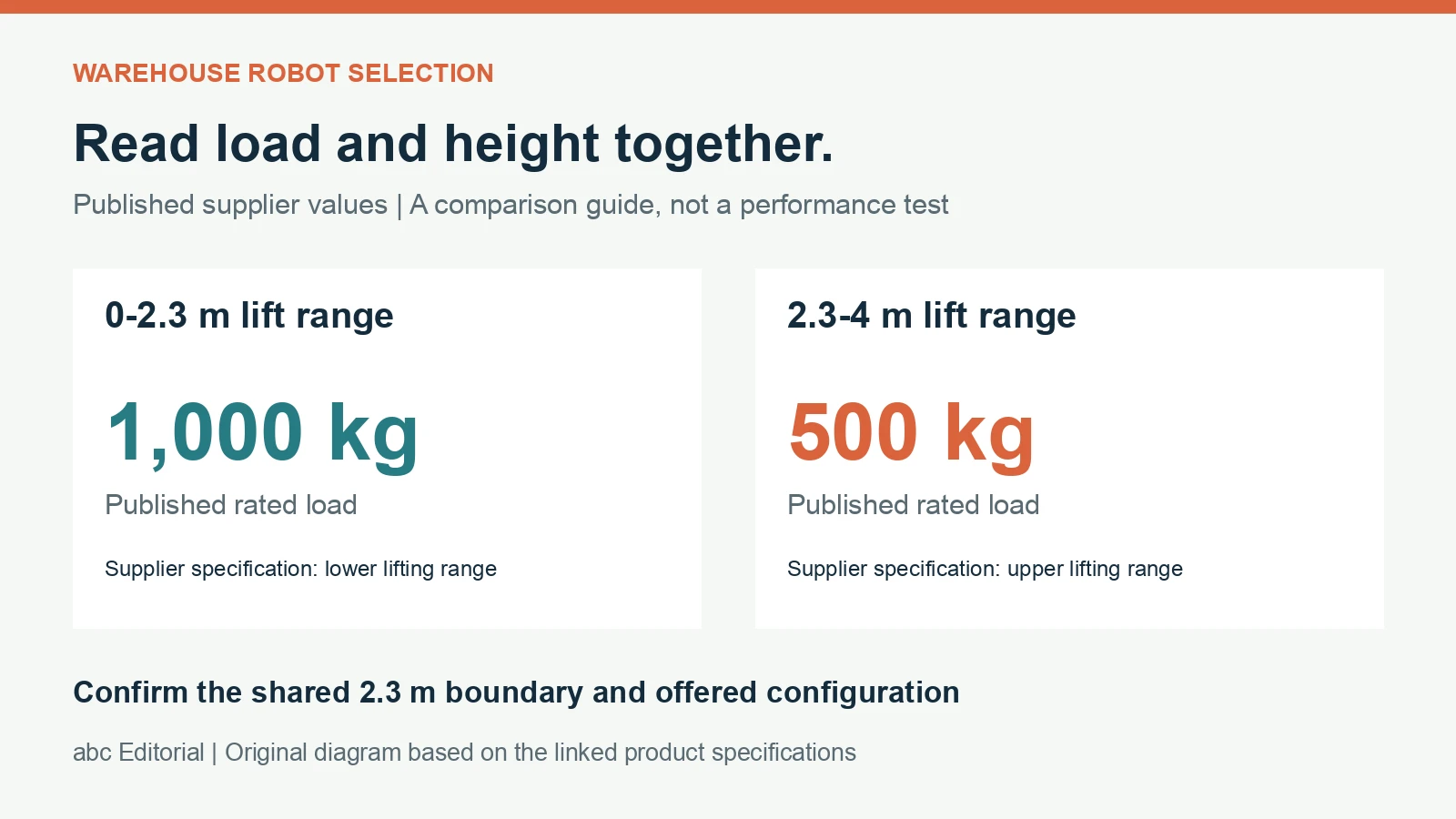
Keep the load and height conditions together
A warehouse robot summary may present maximum load and maximum lifting height as separate headline values. Reading them as a simultaneous operating point can produce the wrong shortlist. The Yuming side-loading AGV is a useful example because its detailed specification separates load capacity into two lifting ranges. This guide explains that particular source document and the questions it leaves open. It does not establish a general load curve for other AGVs or confirm that this product fits a specific warehouse.
Read the two published lifting ranges
The detailed supplier specification lists 1,000 kg for a lifting range of 0–2.3 m and 500 kg for a range of 2.3–4 m. It also lists a maximum lift of 4 m. Those figures do not support a claim that the AGV carries 1,000 kg at 4 m. The intervals share a 2.3 m boundary, and the captured document does not resolve how the boundary is assigned. Request the current load chart and written confirmation for the exact height, load and configuration you intend to use.
Describe the pallet as well as its mass
The official product material lists compatibility with 1.2 by 1.2 metre and 1.2 by 1.0 metre pallets. Outer dimensions alone are not a complete description of pallet handling. Supply a pallet drawing or photographs that show entry openings and the underside, and describe the intended loading arrangement. Ask the supplier to confirm compatibility with those details. The published size list should not be extended to other pallet forms without confirmation, and the directory does not infer an unpublished load-center limit.
Treat aisle width as a configuration check
The specification gives a minimum aisle width of 1.7 m for the stated arrangement. Record the source value, then ask what pallet orientation, clearances and operating assumptions it uses. Provide the available aisle dimensions and the points where the route narrows. A single catalog aisle figure does not document every loading, turning or transfer movement in a building. Request a layout review for the proposed route instead of assuming that any nominally 1.7 m aisle is sufficient.
Request the offered navigation and installation details
Yuming describes multiple navigation approaches at company level. That broad company description is not proof that every configuration is supplied on this particular product. Ask which navigation arrangement is included, what site preparation it requires and how it interfaces with the planned warehouse workflow. Provide the intended transfer locations, storage heights and operating environment. The product page captured for the directory does not supply an exact model code, so the quotation should identify the actual offered model and revision.
Build the inquiry around the unresolved operating point
A useful brief includes the pallet geometry, required load at each storage height, route layout, transfer locations and the proposed working pattern. Keep the lower-range and upper-range capacities separate, and flag the 2.3 m boundary for clarification. Do not translate the 4 m lifting height into robot-arm reach or infer unlisted repeatability. This guide uses official product material with AI-assisted preparation by RobotLineup Editorial. No independent warehouse trial, factory visit or installation acceptance is claimed.
Buyer decision notes
Create a rack-task eligibility worksheet
A warehouse sourcing decision should list each required rack task rather than comparing a maximum load and height as separate figures. Use the original Yuming bands to identify questions and excluded cases, then keep the pallet and route conditions alongside them. This worksheet does not replace a supplier load chart or site review.
Prepared by RobotLineup Editorial · Analysis updated . Platform analysis, not an independent equipment test.
Compare proposals on the same basis
Ask each bidder to answer these items against the same drawings, parts and operating sequence. An unanswered item is a comparison gap, not a passed requirement.
| Decision | Evidence to request | Avoid this assumption |
|---|---|---|
| Required rack task | Gross load, rack height, load centre and pallet dimensions for each task. | One favourable pallet represents every rack level. |
| Published band | The matching height band and its confirmed endpoints for the quoted vehicle. | The overlapping 2.3 m endpoint can be resolved by guesswork. |
| Route and approach | Turning, rack entry and actual pallet clearance in the supplier layout study. | A straight-aisle minimum proves the entire transfer. |
| Delivered configuration | Exact vehicle identity, navigation, interface and commissioning scope. | A company’s range description fixes the delivered setup. |
Mark cases as unresolved instead of extrapolating
A load exceeding the recorded upper band cannot be approved by combining separate maxima. A case at exactly 2.3 m remains unresolved until the supplier clarifies that endpoint. A below-band mass screen is also not a route or pallet approval.
Maintain the task table when pallet weights, rack levels or routes change. Ask whether the quoted configuration and chart still apply. Record the supplier response next to the changed case so the procurement decision has a traceable basis.
Worked sourcing brief
Illustrative procurement exercise. Assumptions below are invented for explanation; this is not a customer case, trial result or quotation.
Assume three gross loads of 450, 700 and 900 kg are requested at 3 m. The 450 kg task is below the recorded 500 kg upper-band figure by mass only; 700 and 900 kg exceed it. None is a completed site approval. Request geometry and route review for the first and alternative task or equipment proposals for the others.
What to record before acceptance
Agree the test method, responsibilities and pass conditions before ordering. The items below are records to request, not a completed validation.
- Save the complete task table and the supplier-confirmed band and boundary information.
- Record the exact tested pallet, route and vehicle configuration.
- Keep commissioning, recovery, charging and warehouse-interface responsibilities with the final proposal.
Common buyer questions
Can I treat every load below 500 kg as approved?
No. A mass screen is only one condition; height, geometry, route and configuration still need review.
Can I use the guide for another vehicle?
Use its worksheet structure, but obtain that vehicle’s own load chart and installation conditions.