
 Compare
 Sign in
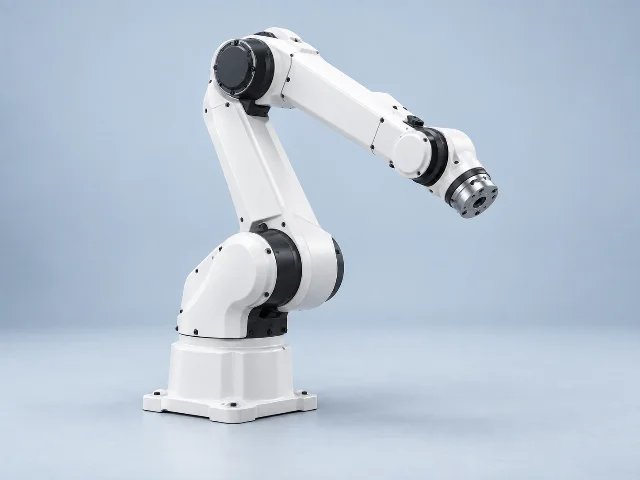
Articulated robots
Multi-joint robot architecture for flexible movement around a workcell.
Define your requirements
- Check the work envelope, tooling load and integration requirements.
Check the motion path, not only the maximum reach
Use a drawing of the entire cell to discuss this architecture. A headline reach value does not describe every reachable pose, tool orientation or collision-free path. Ask the integrator to demonstrate the positions needed for loading, processing and recovery.
Questions to resolve before shortlisting
- Where are the pickup, process and release points relative to the mounting face?
- What is the combined mass of the workpiece, gripper, adapters and services?
- Can the wrist maintain the required orientation throughout the proposed path?
- Which access points must remain available for setup and maintenance?
What to send with your sourcing brief
Provide a cell layout, tool drawing and sequence of required poses. Request a simulation with stated tooling and load assumptions before accepting a model shortlist.
Platform procurement checklist. Confirm the equipment and integration requirements with the supplier.
Buyer decision notes
Select for tool pose and cell access
An articulated-arm shortlist begins with the workpiece and required tool orientations. A model can pass the headline mass and reach filters while still failing the actual task because a fixture obstructs the approach, the wrist cannot hold a required pose or the tool moves outside the available enclosure. Convert the job into a sequence of poses before comparing model names.
Prepared by RobotLineup Editorial · Analysis updated . Platform analysis, not an independent equipment test.
Compare proposals on the same basis
Ask each bidder to answer these items against the same drawings, parts and operating sequence. An unanswered item is a comparison gap, not a passed requirement.
| Decision | Evidence to request | Avoid this assumption |
|---|---|---|
| Motion envelope | A layout showing pickup, process, release and recovery positions, including the tool tip and robot base. | Maximum reach is a guarantee of access at every orientation. |
| Wrist loading | Complete tool and part mass, centre of gravity and the model-specific permitted loading conditions. | A lightweight part means a lightly loaded wrist. |
| Process quality | A trial protocol stating where the tool must be positioned and how the finished result is measured. | A repeatability specification is a finished-part accuracy guarantee. |
| Service access | Clearances for opening fixtures, removing parts and maintaining the tool without moving the cell. | The production path is the only space that matters. |
When to keep the arm on the shortlist
Keep the articulated option when the proposal demonstrates the required approaches and orientations with the complete tool. Ask for the simulated model, mounting arrangement and collision assumptions, not just an animation of an unloaded arm. Where the work can be described as simple transfers between parallel planes, also investigate SCARA or Cartesian arrangements before accepting added motion complexity.
Separate robot motion time from process dwell, fixture movement and operator tasks. When a bidder changes the tool, base location or approach angle to meet the cycle, revisit the original clearance and quality requirements. Treat those changes as proposal revisions rather than silently comparing different configurations.
Worked sourcing brief
Illustrative procurement exercise. Assumptions below are invented for explanation; this is not a customer case, trial result or quotation.
Assume a part must be picked from a tray and placed inside a recessed fixture. A proposed arm reaches both locations when drawn as points. Add the gripper length and the required vertical insertion approach: the fixture wall may now obstruct the tool. Request an approach and retreat demonstration with the fixture geometry. This exercise cannot select an arm or prove that a real installation is collision-free.
What to record before acceptance
Agree the test method, responsibilities and pass conditions before ordering. The items below are records to request, not a completed validation.
- Save the layout revision and a list of demonstrated tool poses, including loading and recovery access.
- Record the exact tool, workpiece, payload configuration and sequence used for the cycle measurement.
- Document the agreed quality check and ask the integrator to identify the system assessment and residual risks.
Common buyer questions
Is more reach always better?
No selection rule follows from reach alone. Ask how the proposed mounting and path satisfy the cell constraints; extra reach does not resolve every orientation or access problem.
Can one arm handle several product variants?
Compare each variant with the same fixture and tooling assumptions. Require a stated changeover method and demonstrate the variant that creates the most demanding access or load condition.