
 Compare
 Sign in
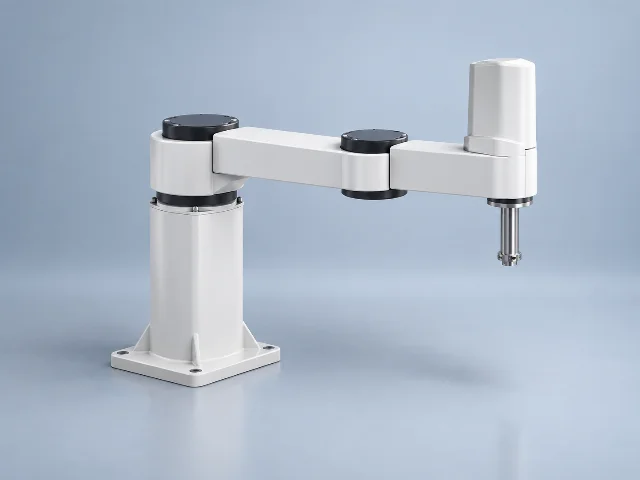
SCARA robots
A compact robot architecture to explore for planar assembly and handling tasks.
Define your requirements
- Define horizontal reach, vertical stroke and tooling requirements.
Separate planar motion from vertical access
For a SCARA sourcing brief, describe the horizontal transfer and the vertical insertion or pickup as separate operations. Include the fixture height and the approach direction. A short headline cycle quoted for a different move is not evidence for your assembly cycle.
Questions to resolve before shortlisting
- What are the horizontal pickup and placement coordinates?
- How much vertical travel is required above and inside each fixture?
- Does the part need rotation, reorientation or another axis outside the proposed motion?
- How will parts be presented and how will an unsuccessful insertion be detected?
What to send with your sourcing brief
Send fixture drawings, part orientation and a timing diagram. Ask the supplier to demonstrate the sequence with the proposed tool and representative parts.
Platform procurement checklist. Confirm the equipment and integration requirements with the supplier.
Buyer decision notes
Evaluate the assembly plane and vertical approach
SCARA selection is useful when the proposed operation is largely a transfer within a plane with controlled vertical pickup or insertion. Start with the fixture and part presentation, then check rotation and vertical access. Do not assume that a model described as fast will achieve the full assembly sequence or accommodate a part that needs a different approach direction.
Prepared by RobotLineup Editorial · Analysis updated . Platform analysis, not an independent equipment test.
Compare proposals on the same basis
Ask each bidder to answer these items against the same drawings, parts and operating sequence. An unanswered item is a comparison gap, not a passed requirement.
| Decision | Evidence to request | Avoid this assumption |
|---|---|---|
| Horizontal transfer | Pickup and placement coordinates referenced to a proposed base and fixture layout. | Two points inside an outline prove a usable transfer path. |
| Vertical stroke | Fixture heights, approach clearance and the required insertion or extraction distance. | Published stroke is all available as useful process travel. |
| Part orientation | The required part rotation at pickup and placement, plus any reorientation operation. | Every orientation can be achieved by a planar assembly arm. |
| Assembly result | Representative parts and a method for detecting missing, misaligned or damaged components. | A successful unloaded motion proves an assembly process. |
Resolve the fixture before comparing speed
Use SCARA as a motion option rather than a complete assembly specification. The fixture must locate the component and the tool must perform the operation within the required approach. If the task needs a tilt into a recess or an approach around an obstruction, ask the integrator to compare another architecture or an additional positioning device.
For a quoted cycle, request the start and end events, the real transfer distance, vertical moves, gripper time and inspection steps. Compare figures only when the sequence and loading match. A catalog move is useful context; it does not replace the proposed workstation timing.
Worked sourcing brief
Illustrative procurement exercise. Assumptions below are invented for explanation; this is not a customer case, trial result or quotation.
Assume a pin is picked from a tray and inserted vertically into a supported component. Add a second variant whose insertion direction is angled. The first fixture concept may fit a planar transfer and vertical approach, but the second requires another tool orientation or a repositioned fixture. Ask bidders to price and explain the variant change rather than treating both as the same task.
What to record before acceptance
Agree the test method, responsibilities and pass conditions before ordering. The items below are records to request, not a completed validation.
- Keep fixture drawings and the part orientation for each accepted variant.
- Measure the cycle with pickup, insertion, release and inspection included in the agreed boundary.
- Record failed-insertion detection and the recovery procedure demonstrated by the integrator.
Common buyer questions
Does a SCARA eliminate the need for a fixture?
No. Ask how the part is supported and located during the operation. The architecture alone does not define assembly tolerance or the response to component variation.
Can catalog cycle times be compared directly?
Only after the motion definition, payload and included operations are matched. Require a timing breakdown for your sequence.