
 Compare
 Sign in
Injection Molding Robot Selection: Payload and Stroke Are Different Checks
What SVAI-850S and SVAW-850S can—and cannot—tell you about a sourcing shortlist.
RobotLineup Editorial · · Updated
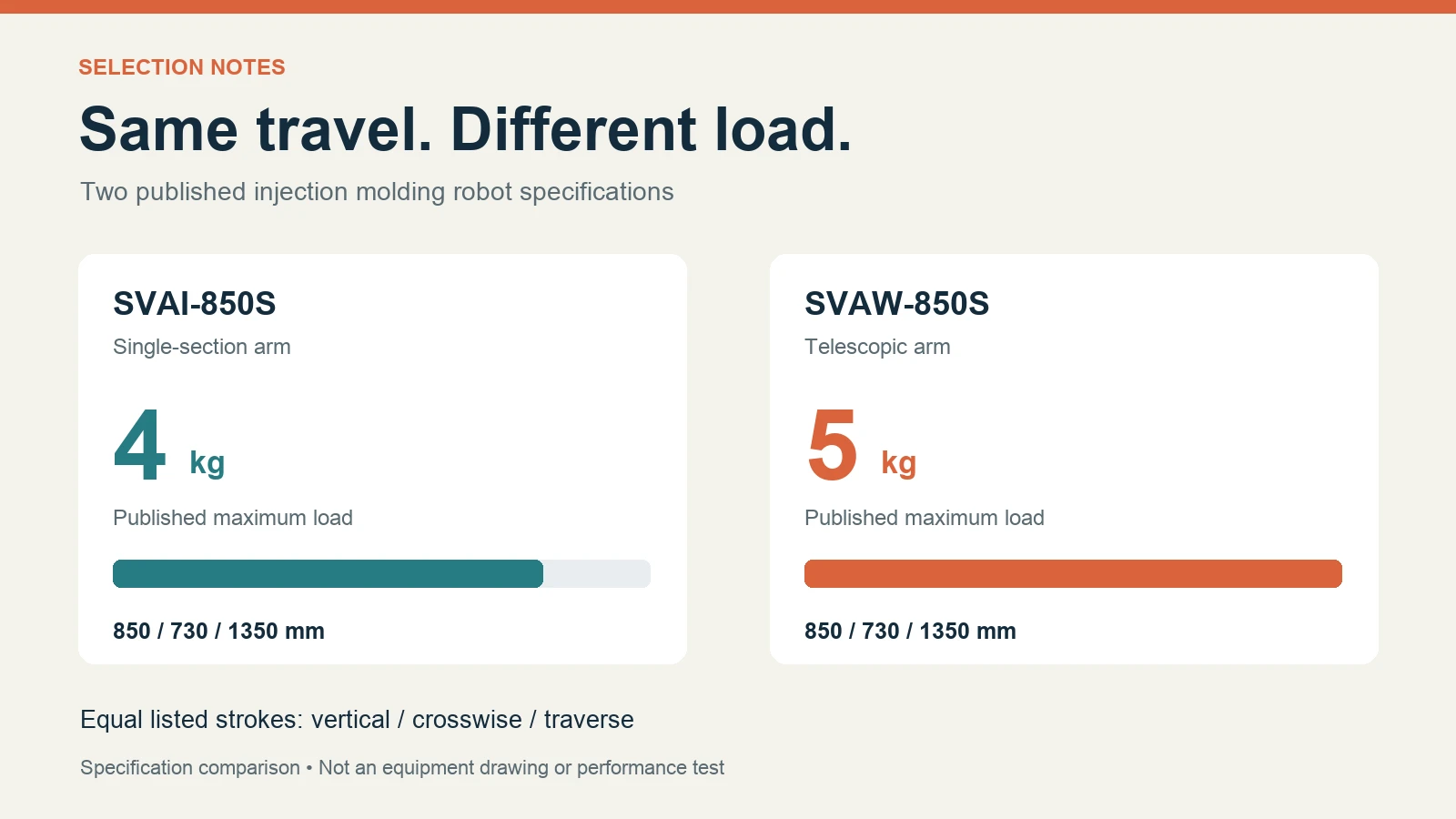
Start with the exact model, not a family name
An injection molding robot family can contain several arm forms, stroke lengths and load ratings. A family photograph or a broad machine-tonnage range does not establish which configuration will fit your production line. Begin a shortlist with the exact model designation and record each published value separately. This guide uses two published SHIP models as a limited comparison: SVAI-850S and SVAW-850S. It is a reading guide for manufacturer specifications, not a performance test or a recommendation that either model fits a particular machine.
Equal strokes do not mean equal equipment
The manufacturer tables list the same three directional strokes for both models: 850 mm vertical, 730 mm crosswise and 1350 mm traverse. Those matching numbers make the pair useful for comparison, but they do not establish identical installation envelopes or motion paths. The SVAI-850S table describes a single-section arm, while the SVAW-850S table describes a telescopic arm. Ask for the dimensional drawing of the actual offered configuration and check the mold opening, take-out path, mounting position and available overhead space with the supplier.
Keep maximum load separate from stroke
The published maximum load is 4 kg for SVAI-850S and 5 kg for SVAW-850S. That difference is independent of the equal stroke values. A buyer should provide the molded part mass and end-of-arm tooling details, and ask the supplier to confirm exactly what its load rating includes. Do not assume the full listed figure is available for the part alone. This directory does not infer an allowable part weight, tool allowance or dynamic limit where the source does not specify one.
Do not translate axis travel into arm reach
For these Cartesian take-out robots, the source gives travel in three named directions. A single reach number would remove information about that geometry. The directory therefore records the three strokes separately and leaves an unpublished reach value unknown. Do not add the strokes together or copy the vertical stroke into a reach field. A comparison with an articulated robot requires its own workspace and application assessment, rather than a conversion between differently defined catalog numbers.
Turn missing information into supplier questions
Before requesting a quotation, attach the injection molding machine model and mold layout, identify the exact robot model and arm form, and describe the part and tooling to be handled. Ask the supplier to confirm the supplied stroke configuration, mounting dimensions, interfaces, utilities and the intended take-out sequence. Request an application-specific cycle assessment instead of treating a catalog take-out time as a guaranteed production cycle. These questions define what still needs confirmation; they are not claims that the platform has validated the installation.
What this comparison establishes
The two source tables support a narrow conclusion: these models share three published stroke values but differ in arm form and maximum load. They do not establish a complete equipment substitution, delivered price, stock availability or measured performance in your plant. The linked model and manufacturer pages provide the corresponding directory records. Prepare a sourcing brief with the unresolved configuration questions and ask for confirmation of the current specification before making a purchasing decision. This guide was prepared by the platform with AI assistance from official product material; no independent equipment test or factory visit is claimed.
Buyer decision notes
Convert the comparison into a supplier decision record
Use the original model comparison above to prepare a configuration decision. A useful record states the buyer’s constraint, the relevant published value, the supplier’s answer and whether that answer resolves the constraint. Avoid declaring a preferred model before the complete carried assembly and machine layout have been reviewed.
Prepared by RobotLineup Editorial · Analysis updated . Platform analysis, not an independent equipment test.
Compare proposals on the same basis
Ask each bidder to answer these items against the same drawings, parts and operating sequence. An unanswered item is a comparison gap, not a passed requirement.
| Decision | Evidence to request | Avoid this assumption |
|---|---|---|
| Mass screen | Part, runner, gripper, adapters and the confirmed supplier rating boundary. | An unweighed tool is negligible. |
| Stroke screen | Required pickup, extraction and discharge coordinates for each axis. | Equal strokes make arm forms interchangeable. |
| Installation screen | Machine, mold and overhead drawings with the quoted arm arrangement. | Machine tonnage is a complete layout specification. |
| Timing screen | Defined take-out motion and full production sequence under representative conditions. | A catalog minimum is a site-cycle guarantee. |
Resolve exclusion criteria before preference criteria
Treat a confirmed load or access failure as an exclusion before discussing a small catalog timing difference. Mark unanswered mounting or rating conditions as pending. Ask the supplier to distinguish an alternative configuration from the exact models compared in the guide.
Keep the proposal version with the decision record. If the gripper or placement changes, revisit load and stroke rather than assuming the earlier shortlist remains valid. This worksheet helps a buyer make the dependencies visible; it is not a commissioned engineering study.
Worked sourcing brief
Illustrative procurement exercise. Assumptions below are invented for explanation; this is not a customer case, trial result or quotation.
Assume both models pass the requested linear travel, but the complete assembly is 4.3 kg under a confirmed total-load definition. That excludes a 4 kg configuration by this screen and prompts review of the 5 kg option. The latter still needs its own mounting and loading approval. Do not use a 0.1-second catalog difference to override an unresolved installation constraint.
What to record before acceptance
Agree the test method, responsibilities and pass conditions before ordering. The items below are records to request, not a completed validation.
- Store the supplier-approved configuration and the measured complete carried mass.
- Record mounting and mold clearance evidence and the selected interface.
- Keep the demonstration conditions and all unresolved items with the purchasing decision.
Common buyer questions
What if the supplier proposes a different model?
Request a separate model-specific specification and drawings. Do not replace the guide’s figures without a reviewed update.
Should a missing value be entered as zero?
No. Mark it unknown or pending and request the relevant evidence.